A story to read
Six Minutes is told through the documents a family leaves behind: a birthday video, a bill, CCTV from the pub, and the robot’s own reasoning, entered as evidence.
Read Six MinutesI develop original future scenarios, design fiction and decision games for strategy, policy and innovation teams. I follow the incentives, institutions and human choices that could make an unfamiliar future real.
The futures your process won’t produce.
You may already have forecasts, trend reports and scenarios. I can work alongside them, or start with a question that hasn’t found a place in your planning yet.
“When Antony speaks in our futures meetings, there’s a change of gear. He connects ideas across sectors and opens up possibilities we might otherwise miss. He gets the best out of the people in the room, challenging familiar assumptions and bringing difficult but important questions into the open. His scenarios get people to experience possible futures and work through what they would mean for the decisions they face today.”
Take one, or combine them.
Looking for a documentary? See how film commissions work
One question, one finished piece. I find the future your subject leaves out and build it out: who wants it, how it spreads, what it commits people to and what it changes for your decisions. The assumptions come with it.
You understand the technology. You need someone to imagine what people will build a business around, and what that will do to yours.
An ageing population becomes a military resource. A zoo becomes an arcade. Advertising becomes the reason to watch.
An outrageous premise, developed far enough to argue with. For away days, innovation sprints and strategies that have stalled.
A restaurant sells the pleasure of moral disapproval, and its enormous bills really do fund conservation.
I follow an idea across industries until separate futures add up to one shift: the kind that creates a dozen businesses, not one.
A robot skills store, a food cartridge and an invention engine all point to the same scarce resource: permission. That’s the Permission Economy.
Who would want it, what they would build, how they would pay and why others would join in. For scenario teams, consultancies and writers’ rooms.
A robot deer leads to a multiplayer zoo, spectators, betting and a new relationship with wildlife.
A story to read, an exercise script to play or a film treatment to shoot, with the evidence and assumptions alongside. For teams facing decisions nobody can solve with a slogan.
An argument about electricity became a live-action game: you decide whose advice the minister takes, then live with the future you chose.
Bring a subject, a technology, a question or a body of research. I look for the overlooked possibility and the assumption worth reversing.
Who would want it? What would they build? How would they pay? Why would others join in? The world develops through understandable motives and choices.
Carry the idea into other businesses, institutions and daily lives. The connections can reveal a larger paradigm, or change the original idea.
A grandmother under pressure to enlist. A family paying for a cool room they have never used. The owner taking sides in an argument between basil and tomato.
A story, an exercise script, a film, a game, a front page, a recruitment campaign or a contract, from inside the world.
Options to compare, assumptions to test and developments to watch, tested in workshops and wargames against rivals, regulators and the public. For negative territorial power: who insures the farms, who protects the villages, and what an alliance must promise before the first robot lands.
Your experts can brief the evidence. The hard part is making people feel a choice before they have to make it. I research the issue, build a plausible world around it and put your people inside a decision they can’t solve with a slogan.
Every piece comes with the evidence and assumptions behind it, so your specialists can check each step.
Six Minutes is told through the documents a family leaves behind: a birthday video, a bill, CCTV from the pub, and the robot’s own reasoning, entered as evidence.
Read Six MinutesExercises and wargames in which your people play the rivals, regulators and public as well as themselves. I designed them for UK government and NATO audiences for five years.
Workshops and wargamesBalance of Power turned an argument about electricity into a live-action game, and won the Energy Institute’s Public Engagement Award.
See Balance of PowerIt takes four kinds of experience that rarely meet in one person. Physics and modelling (statistics, system dynamics, agent-based models), to interrogate the premise. Five years in credit derivatives, to follow the incentives, contracts and ownership. Documentaries from a year on a Soviet test site to Donetsk, to find the people and the conflict. And five years of strategic games at Dstl, to turn that conflict into decisions.
Your team builds the newspaper, the manual and the product catalogue from your own future. Then it plays your competitors reacting to them.
Morning
Work backwards from a design fiction. Find the changes and choices that could make it ordinary. Then take your own field beyond its first obvious answer.
Afternoon
Teams take the roles of different organisations, develop their responses and discover how their ideas collide. Then they change roles and go again.
You finish with design fictions from one possible world, and a map of the relationships and consequences that emerged.
Workshop
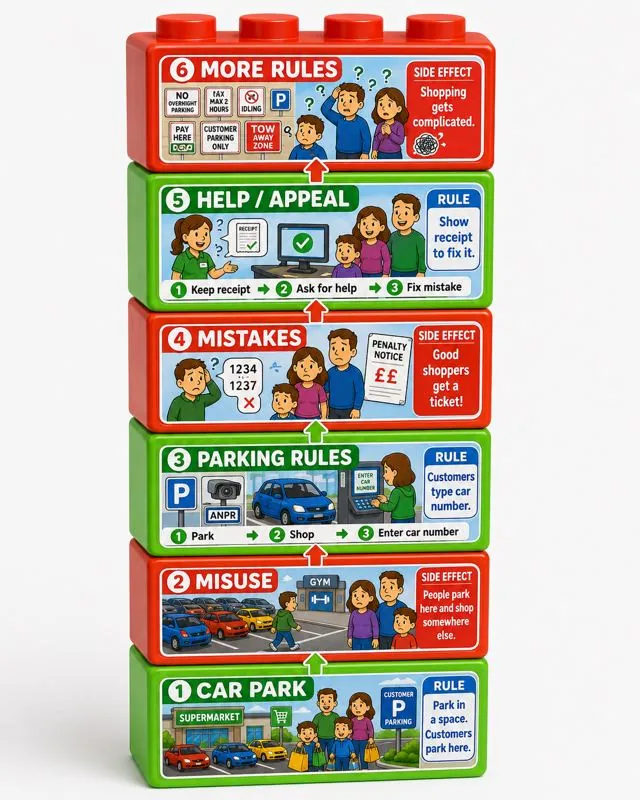
Why does a supermarket ask for your car registration?
Nobody designed the world you live in. Teams dig back through the problems and solutions that put that machine there, one brick at a time, then build forwards into a future of their own. One rule: add a brick only when the bricks below give a reason for it.
It works on any subject: a hospital ward, a supply chain, a border.
Play the decision before you make it.
Your people play rivals, regulators, customers and the public as well as themselves, then follow each other’s moves into consequences. I designed exercises and wargames for UK government and NATO audiences for five years at Dstl.
Talks, keynotes and screenings followed by questions.
I’ve spoken at Chatham House and Ministry of Defence forums, and screened my films at festivals and universities from Sheffield to Toronto.
Embedded
A set period inside your team. I run the sessions, write the worlds and leave your people able to do it themselves.
Talk about thisOngoing
Monthly time for sparring, research and scenario work as questions come up.
Talk about thisBring me in for the ideas, the worlds, the wargame or the film, inside your process and your client relationship. I work with your research and specialists, and bring the futures your process wasn’t going to produce.
Talk about collaboratingFor the whole journey, I work with Simon through Speculative Edge, a futures consultancy. You can join at any stage.
A subject, a technology, a brief, or something you can’t quite put your finger on yet. A few lines is enough.